Why Your Website Is Your Competitor's Margin
Your margin is my opportunity.
Bezos didn't say it about websites. He said it about inefficiency. But the principle applies perfectly to the digital gap between service businesses and their competitors.
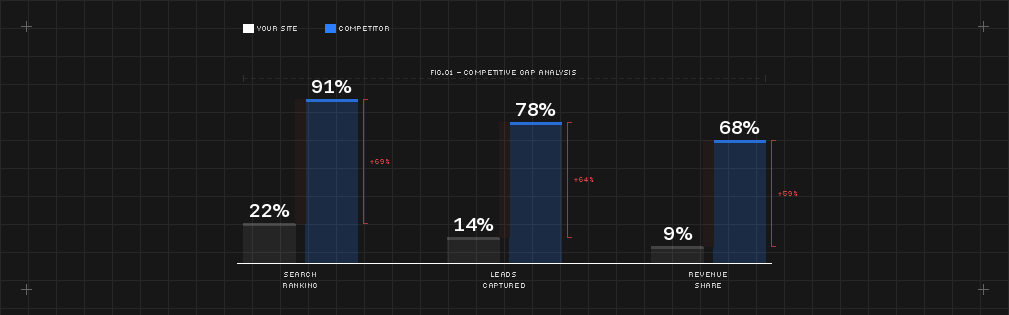
Here's the dynamic: You're an excellent electrician, builder, or clinic owner. Your work is solid, your reputation is local, and your customers trust you. But your website tells a different story. It looks like something your nephew built in 2015. Your competitor's website, even though they're less experienced, looks like they've got an operation twice your size.
The trust gap is the margin. And your competitor is exploiting it.
What the margin actually is.
Your margin isn't money. It's credibility.
When a prospective client lands on your website, they're not assessing your technical skill — they haven't worked with you yet. They're assessing whether you look like someone who can do what you say. A weak website doesn't prove your work is weak; it proves your judgment is weak. And judgment matters.
For trades: A builder with a professional website signals quality standards, systems, professionalism. A builder with a cheap website signals cost-cutting.
For specialist services: An allied health clinic with a thoughtfully designed site signals competence and care. A cluttered one signals disorganization.
The client doesn't consciously think this way. But their behavior shows it. They call your competitor first. They assume higher quality. They're willing to pay more.
That margin — the jobs you lose, the price premium you miss — is the opportunity your competitor is seizing.
How they exploit it.
It doesn't take a better service business to win your work. It takes a better website.
A competitor with a weaker track record but a sharper site will:
- Be found first. Clean sites rank better and appear more credible.
- Be contacted first. Clear CTAs, testimonials, and process explanation lower friction.
- Be trusted first. Visual consistency and intentional design convey competence.
- Close at a higher rate. Professionalism compounds confidence.
You've already done the hard work — the groundwork, the referrals, the reputation. Your competitor is just skimming the margin you left on the table.
Where the margin sits.
The gap isn't complicated. It's usually these specifics:
Clarity of positioning.
Your site doesn't explain who you serve and why you're different. Visitors can't quickly answer: "Should I hire this person?" A clear positioning statement changes this immediately.
Social proof architecture.
Testimonials scattered randomly don't work. Photos of completed jobs without context don't work. Third-party reviews buried in a footer don't work. When proof is organized strategically, before the visitor's doubt, conversion improves measurably.
Process transparency.
People buy confidence. When you show your process, how you work, what to expect, and what outcomes look like, you replace uncertainty with familiarity. Your competitor's site doesn't show this. Yours should.
Visual authority.
Not beautiful design. Intentional design. Every color choice, spacing decision, and image selection serves a single purpose: convince someone you know what you're doing. Randomness erodes that. Intention builds it.
Conversion clarity.
Your site probably doesn't have a clear next step. "Contact us" buttons that lead nowhere. No phone number. No email. No indication of how fast you respond. Your competitor's site makes it frictionless to reach them.
How to close your margin.
This is the methodology:
- Map your positioning. Who specifically do you serve? What outcome do you deliver that competitors don't? Write it down in a single sentence. This becomes your North Star.
- Audit your proof. List your best testimonials and completed projects. Organize them by outcome: faster timelines, cost savings, quality, reliability. This becomes your testimonial architecture.
- Document your process. How do you work? What are the phases? What can a client expect at each stage? Make this visible on your site.
- Design for intention. Every element: color, copy, spacing, imagery, supports your positioning. No decoration. No trend-chasing. Strategy first.
- Close the funnel. Make it impossible for a prospect to not know how to hire you. Phone, email, booking link, clear next step. No friction.
This isn't complicated. It's just intentional.
The cost of inaction.
Every month your website underperforms, your competitor is winning jobs you've earned through years of groundwork. The margin compounds. They build momentum, confidence, reviews. They get selective about clients. You keep chasing.
Your margin is their opportunity. Until it isn't.
Book a discovery call.
We'll audit your current site, identify the margin, and show you exactly how to close it.