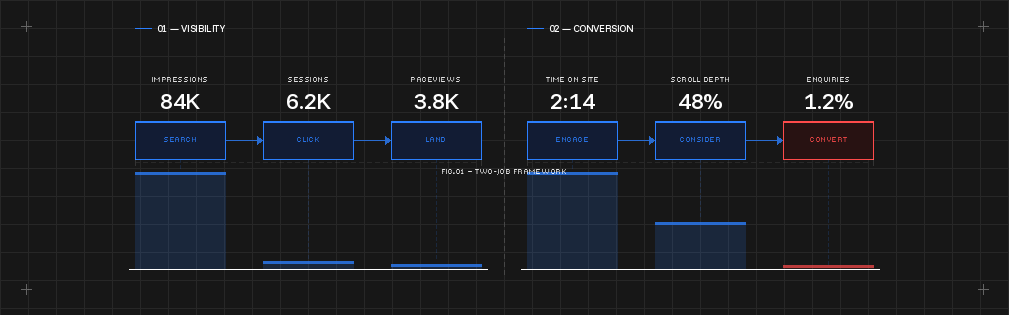
The Two Jobs of a Website: Visibility and Conversion
Most business websites do neither job well. They are visible to the wrong people, or invisible to the right ones. They look polished but quietly leak buyers at every step. The site exists, the brand is on it, and yet nothing meaningful happens.
A website only has two real jobs. Get found, and get chosen. Visibility brings the right people in. Conversion turns those people into customers. Everything else is decoration.
If your site is not actively doing both, it is not a strategic asset. It is a brochure with a domain name. This article breaks down what each job actually requires, why most sites fail at one or both, and how a brand-first studio approaches the architecture that fixes it.
Two jobs. One funnel.
Visibility brings the right people in. Conversion turns them into customers.
Why most websites fail at both jobs
Most sites are built around the wrong question. The brief is usually some version of "make it look nice" or "make it modern." Aesthetics are treated as the deliverable. Strategy is treated as a bonus.
The result is predictable. The site looks fine. Traffic is low because nothing is structured for search. The few visitors who arrive cannot quickly tell what the business does, who it is for, or what to do next. They leave. The owner blames the algorithm, the market, or the ad spend. The actual problem is upstream.
A pretty website with no visibility is a private gallery. A visible website with no conversion is a leaky funnel. Neither one is a business asset.
The two jobs are not in conflict. They reinforce each other. SEO drives the right people to the page. Conversion architecture decides whether those people become revenue. Treating them as separate problems, or worse, ignoring one entirely, is what keeps strong businesses underperforming online.
Job 1: Visibility — get found where buyers are searching
Visibility is the inbound half of the website. It is the system that ensures the right people, searching for the right thing, end up on your page rather than a competitor's.
This is not about chasing every keyword. It is about ranking where your buyers actually look, with content and structure that signals authority to both search engines and humans.
What real visibility requires
- Keyword strategy with intent. Buyer-intent keywords beat vanity volume every time. Ranking page one for a term nobody buys from is a bragging right, not a result.
- On-page architecture. Titles, meta descriptions, headings, internal linking and URL structure all need to map to how search engines index and how readers scan.
- Technical performance. Site speed, mobile responsiveness, crawlability and clean code are non-negotiable. Slow sites lose rankings and visitors before content even loads.
- Content depth. Thin pages do not rank. Useful, structured, opinion-led content that genuinely answers a buyer's question is what search engines now reward.
- Local and authority signals. For service businesses, Google Business Profile, citations and authoritative backlinks compound visibility over time.
Visibility is not a one-off project. It is a discipline. A site that ranks well in 90 days needs to keep being maintained, updated and refined to stay there.
Job 2: Conversion — turn visitors into customers
Visibility is wasted if the site cannot convert. Conversion is the architecture that takes a visitor from arrival to enquiry, to call, to client.
This is where most service businesses lose the most revenue, often without realising it. Traffic is fine. The site looks good. But the homepage is unclear, the offer is buried, and the call-to-action is one of three competing options. Visitors leave because the site never gave them a reason to stay.
What real conversion requires
- Clarity above everything. Within five seconds, a visitor should know what you do, who you do it for, and what to do next. If they cannot, no amount of design will save the page.
- A single, obvious next step. One primary call-to-action per page. Multiple CTAs competing for attention dilute every one of them.
- Trust signals at the right moments. Testimonials, case studies, named clients and visible outcomes placed exactly where doubt creeps in, not crammed into a single section.
- Friction removed from enquiry. Long forms, vague booking processes and hidden contact details all kill conversion. The path to a conversation should be the shortest, clearest line on the page.
- Architecture that mirrors the buying decision. Premium buyers do not convert the same way as bargain shoppers. The page structure has to match how your real customer actually thinks.
More traffic will not fix a site that cannot convert. It will just expose the leak faster.
Why one without the other is a strategic dead end
A site that converts well but has no visibility is a beautifully engineered shopfront on an empty street. Nothing reaches it.
A site that gets traffic but fails to convert is the opposite. People arrive, look around, and leave without a trace. The analytics dashboard fills with sessions and bounces. The pipeline does not.
Both states are expensive. Both are common. Both come from the same root cause — building a website without a clear answer to the question, what is this site actually supposed to do?
When visibility and conversion are designed together, the website stops being a cost and starts behaving like a system. Every page has a job. Every section earns its place. Search drives the right traffic in. Architecture turns that traffic into revenue.
The brand layer that ties both jobs together
Visibility and conversion are mechanical. Brand is what makes them work at the level a serious business needs.
A premium service business ranking on page one with a generic, template-looking website still loses. Buyers who searched, found, and clicked will judge in seconds whether the brand matches the level they expect to pay for. If the digital presence looks smaller than the business, the buyer quietly assumes the business is smaller than it is.
This is the gap most studios miss. SEO agencies optimise for traffic. Generic web designers optimise for aesthetics. Neither closes the gap between what the business is and how it is perceived online.
Authority is not declared. It is designed. The website is where buyers decide whether to take the business seriously.
Brand-first architecture treats visibility and conversion as the two visible outputs of a deeper system — strategic positioning, then visual identity, then site structure, then SEO and conversion mechanics layered on top. Built in that order, the site does both jobs without compromise.
How to audit your own website against both jobs
A useful starting point is a short, honest audit. Open your homepage and ask:
Visibility check
- Do you rank on page one for the search terms your actual buyers use?
- Are titles, meta descriptions and H1s written for intent, not internal jargon?
- Does the site load fast on mobile, with no layout shifts or broken assets?
- Is there enough useful content to be considered authoritative on your topic?
- Does Google Business Profile, where relevant, mirror what the site says?
Conversion check
- Within five seconds, is it obvious what you do and who it is for?
- Is there one clear next step on every page, or several competing ones?
- Do trust signals appear where doubt naturally arises, not all in one block?
- Is the path to enquiry short, frictionless and visible from any page?
- Does the site feel like the level of business you actually run?
If you answered "no" or "not sure" to more than two of these, the site is leaving money on the table — usually a lot more than the cost of fixing it.
Need both? Let's talk.
Pixel Haus builds brand-first websites engineered to do both jobs — visibility and conversion — at the level ambitious businesses operate at. Strategy, identity and digital architecture, as one system.
Book a 30-minute discovery call to map your site's gaps and the system to fix them.